
If you own a home in Keller or anywhere across North Texas, one roofing question eventually becomes important: how long does a roof last in Texas?
The answer depends on much more than the material listed on your roofing estimate. Texas roofs are exposed to intense summer heat, UV radiation, strong thunderstorms, hail, high winds, temperature changes, and periods of heavy rain. Installation quality and maintenance also have a major effect on how long a roof remains effective.
For homeowners, knowing the expected average lifespan of a shingle roof and understanding how other roofing materials compare makes it easier to plan maintenance, recognize warning signs, and decide when replacement may be appropriate.
How Long Does a Roof Last in Texas?
There is no single lifespan that applies to every Texas roof. Asphalt shingles, architectural shingles, metal, tile, and other roofing materials can have significantly different service lives.
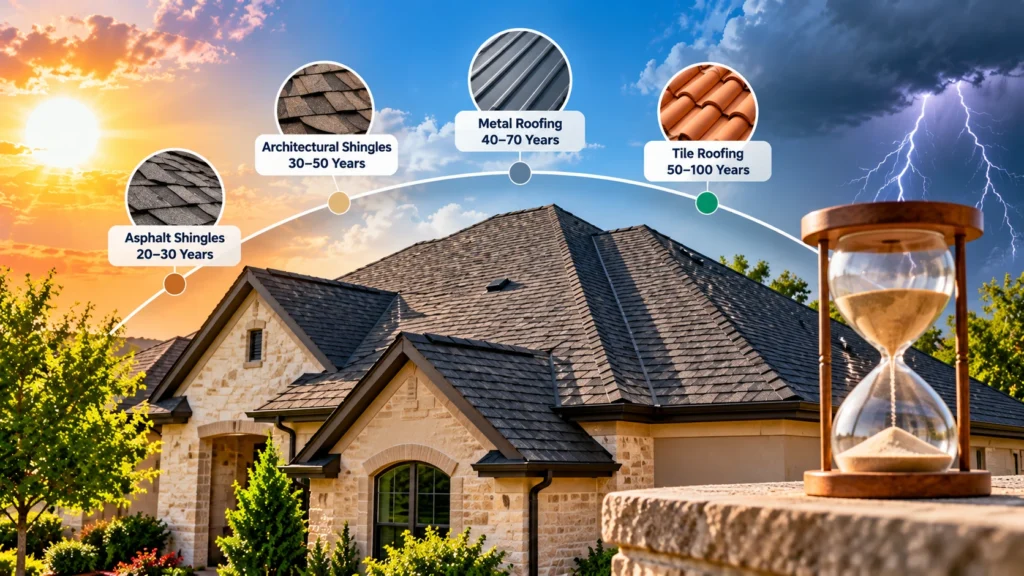
As a general reference, GAF lists typical lifespans of about 20–30 years for three-tab asphalt shingles, 30–50 years for architectural asphalt shingles, 40–70 years for metal roofing, and 50–100 years for clay or concrete roofing products. Actual performance can vary considerably depending on climate, installation, maintenance, and storm exposure.
For a Keller homeowner, however, the calendar should only be the starting point. A 20-year-old roof that has been properly maintained may perform better than a newer roof that has experienced repeated hail or wind damage.
Average Lifespan of a Shingle Roof
Traditional asphalt shingles remain one of the most common residential roofing choices because they combine affordability, appearance, and relatively straightforward installation.
The average lifespan of a shingle roof depends heavily on the type of shingles installed.
Three-tab shingles generally have a shorter expected service life than architectural shingles. Architectural shingles use a dimensional design and are available in a wide range of performance levels, including products designed for stronger wind and impact resistance.
Texas homeowners should also consider the difference between a manufacturer’s warranty and the roof’s actual service life. A warranty does not mean the roof will automatically remain in perfect condition for that entire period.
Proper installation, attic ventilation, flashing, maintenance, and storm exposure all influence real-world performance.
Homeowners looking for residential roofing options can review Qualitas Roofing’s residential roofing services for more information about roofing systems and replacement considerations.
How Texas Heat Affects Your Roof
Understanding how Texas heat affects your roof is critical when estimating its lifespan.
During North Texas summers, roofing materials can experience prolonged exposure to high temperatures and intense ultraviolet radiation. Repeated heating and cooling can also create expansion and contraction within roofing components.
Over time, this combination can contribute to aging, granule loss, brittleness, deterioration of sealants, and other forms of material wear.
Heat is not necessarily going to cut a roof’s lifespan in half, but it is one reason Texas homeowners should not compare roof longevity directly with roofs installed in cooler climates.
Roof ventilation also matters. A properly designed attic ventilation system helps manage heat and moisture within the attic space. While ventilation cannot stop normal roofing aging, it can be an important part of maintaining the overall roofing system.
How Long Does a Metal Roof Last?
One reason homeowners consider metal roofing is longevity.
So, how long does a metal roof last? Typical estimates often place metal roofing in the 40–70 year range, although some systems can potentially last longer when properly selected, installed, and maintained.
Metal roofing can also provide strong durability and energy-related advantages, but it is not completely immune to Texas weather. Hail, debris, wind, scratches, dents, and installation problems can still affect a metal roof.
The Texas Department of Insurance notes that metal roofs can potentially lower insurance premiums, but discounts vary by insurer, and metal roofing may cost more to install. TDI also points out that metal roofs can still suffer cosmetic damage from hail or other impacts.
This makes metal an option worth evaluating, but not necessarily the best choice for every home.
[cta]
Signs Your Roof May Be Nearing the End of Its Life
Roof age becomes more important when it is accompanied by visible deterioration.
Watch for:
- Missing, cracked, curling, or deteriorating shingles.
- Increasing granule loss.
- Repeated leaks or water stains.
- Damaged or deteriorated flashing.
- Sagging areas.
- Moss, algae, or moisture-related problems.
- Frequent repairs following storms.
- Significant hail or wind damage.
- A roof that is approaching the upper end of its expected service life.
A roof does not automatically need replacement because it reaches a particular birthday. Condition should always be evaluated alongside age.
That is why a professional roof inspection service can be useful when you are unsure whether an older roof still has meaningful service life remaining.
How to Make Your Roof Last Longer
Knowing how to make your roof last longer can help you protect your investment.
Regular inspections are one of the most effective steps. The Texas Department of Insurance recommends having a roof inspected every few years to identify problems early. TDI also recommends removing tree limbs near the roof, checking for storm damage, and keeping gutters clean.
Other practical steps include keeping gutters and drainage paths clear, addressing damaged flashing promptly, maintaining attic ventilation, and having storm damage evaluated rather than allowing small problems to remain unresolved.
After a major hail or windstorm, do not rely only on what you can see from the ground. Some roofing damage is difficult to identify without a closer inspection.
Roof Age and Home Insurance in Texas
The relationship between roof age and home insurance in Texas deserves special attention.
Texas Department of Insurance guidance explains that some policies pay replacement cost, while others may pay actual cash value, which accounts for depreciation based on the roof’s age and condition. Some insurers may also change roof coverage as the roof gets older.
There is also an important current development for Texas homeowners. On September 29, 2026, TDI clarified that insurers cannot decline or nonrenew a homeowner solely because the house or roof is old. However, insurers can consider the physical condition of the roof and other components when making underwriting decisions.
In practical terms, an older roof can still affect insurance coverage, premiums, or claim payments because condition and policy language matter, even when age alone cannot be the sole reason for denial or nonrenewal.
Homeowners should review their policy and ask their insurance agent whether the roof has replacement-cost or actual-cash-value coverage.
When Should Keller Homeowners Replace a Roof?
Replacement generally becomes more reasonable when the roof has widespread deterioration, recurring leaks, extensive storm damage, or is approaching the end of its expected service life.
The decision should also account for repair history. If an aging roof requires repeated repairs every time a major storm passes through North Texas, continuing to spend money on isolated repairs may eventually become less practical than replacing the roofing system.
Before making that decision, get a professional assessment rather than relying solely on roof age.
For homeowners looking for a roofing company in North Fort Worth, choosing an experienced contractor who understands local weather exposure, installation requirements, and roofing materials can help make the evaluation more useful.
Qualitas Roofing provides information about its broader roofing services and the communities it serves through its service areas.
Commercial and Residential Roof Lifespans Are Different
Residential homeowners should also avoid comparing their roof directly with a commercial roofing system.
Commercial buildings often use different materials and low-slope roofing systems, which have different installation methods, maintenance requirements, and expected lifespans.
If you own or manage commercial property, you can review Qualitas Roofing’s commercial roofing services for information specific to commercial applications.
For residential projects, the key is to evaluate the material, installation, age, condition, and exposure of the actual roof on the property.
How a Professional Inspection Helps
A professional inspection can turn a simple age estimate into a much more useful assessment.
Instead of asking only, “How old is my roof?”, homeowners should ask:
What condition is my roof in today?
An inspection can help identify visible deterioration, storm damage, flashing problems, potential moisture intrusion, and other concerns that may not be obvious from the ground.
If you’re researching a roof inspection in Roanoke, TX, or another North DFW community, professional evaluation can help you determine whether your roof needs maintenance, repair, or replacement.
You can learn more about Qualitas Roofing through its About page and explore additional roofing information through the company blog.
Final Thoughts
So, how long does a roof last in Texas? For many homeowners, asphalt shingle roofs can provide decades of service, while architectural shingles, metal, and tile systems can offer different longevity depending on the product and conditions.
The Texas climate can be demanding, particularly in the DFW area. Heat, hail, wind, installation quality, ventilation, maintenance, and storm exposure all influence real-world roof performance.
The smartest approach is to monitor your roof throughout its life rather than waiting for a major leak. Regular inspections, prompt repairs, proper maintenance, and timely replacement can help prevent a small roofing issue from becoming a much larger problem.
If you’re unsure about the condition or remaining life of your roof, contact Qualitas Roofing to discuss an inspection or roofing evaluation.
[cta]
Frequently Asked Questions
How long does a roof last in Texas?
A roof’s lifespan depends on the roofing material, installation quality, maintenance, ventilation, and exposure to Texas heat, hail, wind, and storms. Asphalt shingles commonly last several decades, while metal and tile systems can last significantly longer.
What is the average lifespan of a shingle roof?
Three-tab asphalt shingles are commonly estimated at around 20–30 years, while architectural asphalt shingles can commonly reach about 30–50 years under suitable conditions. Actual lifespan varies based on weather, installation, maintenance, and the specific product used.
How long does a metal roof last?
A metal roof can commonly last around 40–70 years, depending on the metal type, coating, installation, maintenance, and environmental exposure. Some systems may last longer when properly maintained.
How does Texas heat affect your roof?
Intense heat and ultraviolet exposure can contribute to material aging, while repeated heating and cooling can place stress on roofing components. Proper ventilation, quality installation, and routine maintenance can help the roofing system perform better over time.
How can I make my roof last longer?
Keep gutters clear, trim branches near the roof, maintain proper attic ventilation, inspect the roof periodically, and address damaged shingles or flashing promptly. TDI specifically recommends checking roofs after storms and having them inspected every few years.
Does roof age affect home insurance in Texas?
Roof age and condition can affect coverage and premiums depending on the policy. Some policies reduce coverage based on age and condition or use actual-cash-value calculations. However, as of September 29, 2026, Texas rules clarify that insurers cannot deny or nonrenew solely because a home or roof is old.
When should I replace my Texas roof?
Replacement should be considered when an older roof has widespread deterioration, recurring leaks, significant storm damage, or frequent repair needs. Age alone does not automatically mean replacement is necessary; overall condition should be evaluated by a qualified roofing professional.
How often should I have my roof inspected?
Texas homeowners should consider periodic professional inspections, especially as the roof gets older or after significant storms. TDI recommends having a roof inspected every few years and checking for damage following severe weather.