
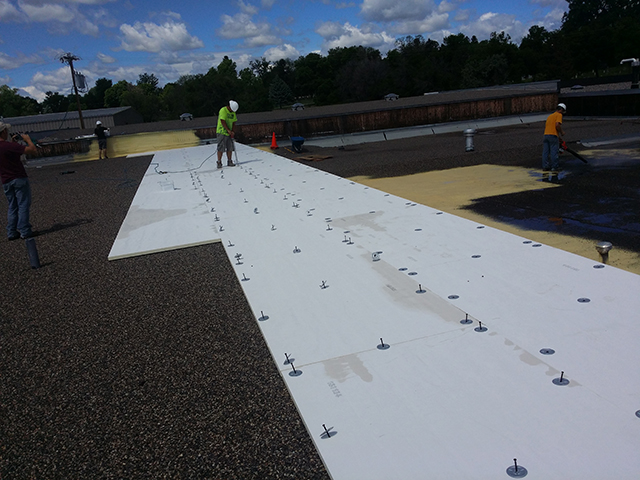
Commercial roof replacement is a major capital decision. The right time is rarely determined by age alone. Condition, leak history, repair frequency, moisture, drainage, rooftop traffic, operational risk, and the owner’s plans for the property all shape the decision.
When repeated repairs become a planning signal
A repair is valuable when the problem is isolated and the surrounding roof remains serviceable. It becomes less useful when new leaks continue appearing in different locations, compatible materials are difficult to integrate, or each repair addresses only one symptom within a broadly deteriorated system.
Six conditions that deserve closer evaluation
- Recurring leaks: Problems return after several unrelated repairs.
- Widespread deterioration: Seams, flashings, penetrations, or surface materials show broad decline.
- Moisture below the surface: Wet insulation or substrate conditions extend beyond one repairable area.
- Drainage problems: Persistent ponding or poor transitions continue stressing the system.
- Operational exposure: Leaks threaten occupants, inventory, equipment, records, or business continuity.
- Budget inefficiency: Emergency work and recurring repairs make planned replacement easier to justify.
What a commercial roof evaluation should consider
A useful evaluation connects visible conditions to the history and use of the building. Review available roof records, warranties, repair invoices, leak locations, drainage, rooftop equipment, access points, and areas with frequent service traffic. Where appropriate, moisture investigation can help define whether the concern is isolated or widespread.
[cta]
Replacement planning should include the operation
The roof cannot be planned separately from the property below it. Commercial owners should identify sensitive operations, occupied areas, access restrictions, staging locations, noise limitations, security requirements, delivery schedules, and rooftop equipment coordination before work begins.
A planned replacement creates time to coordinate the project. An emergency replacement lets the failure choose the schedule.
Repair now or start replacement planning?
The answer may be both. A defined repair can stabilize an urgent condition while the owner develops the budget, scope, and schedule for replacement. The important distinction is whether the repair is expected to provide useful service or merely postpone an unavoidable project without reducing risk.
Questions to ask before requesting proposals
- Which areas and components are included in the replacement scope?
- What existing conditions could change the work after tear-off begins?
- How will occupied areas, entrances, deliveries, and rooftop equipment be handled?
- What property protection and cleanup procedures are planned?
- How will changes, photographs, and project records be communicated?
- Does the schedule account for weather and operational restrictions?
Frequently asked questions
Does an older commercial roof always need replacement?
No. Age is one factor. The current condition, moisture, repair history, materials, drainage, and operational risk provide a more useful basis for the decision.
Can a repair help while replacement is being planned?
Sometimes. A focused repair may stabilize an isolated urgent condition while the owner develops the replacement scope, budget, and schedule. The surrounding roof must still be evaluated.
Does Qualitas install roofs on new commercial construction?
No. The current commercial offering is focused on replacement and repair for existing commercial and industrial buildings.